10min read
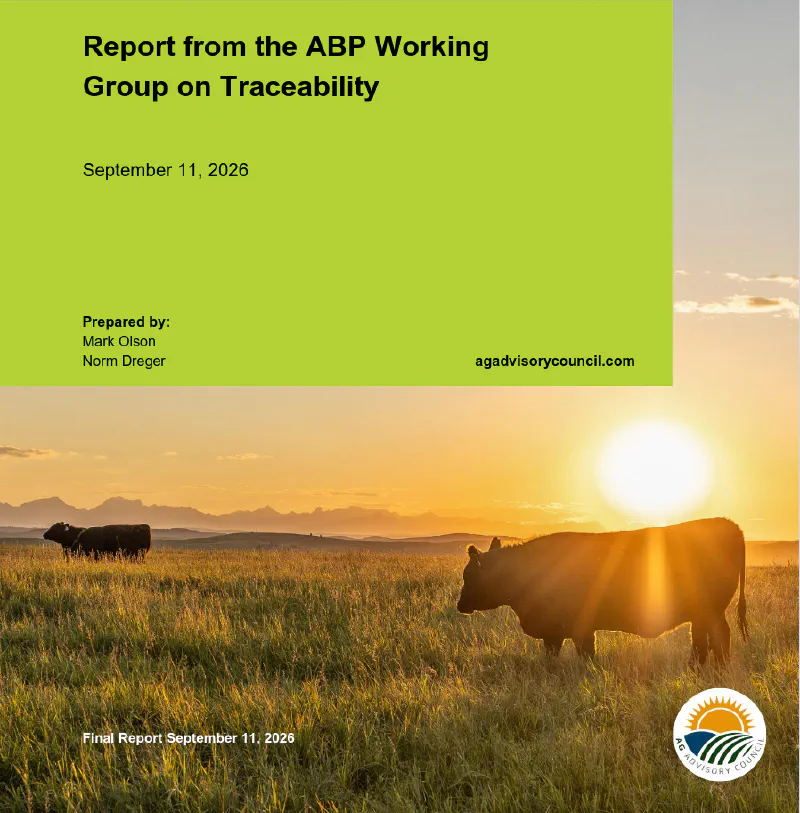
Thank you Alberta Beef Producers (ABP) for your initiative and urgency, and for delivery in just a few months, of the comprehensive and actionable “Report from the ABP Working Group on Traceability” (the Report).
Since March of 2025 Flokk has advocated, just as the Report does, for an industry led solution to beef traceability; Time to pull this calf ourselves: Canada’s livestock industry must find our own path to traceability.
The Report, which we encourage every stakeholder read, identifies five “Conditions for success”, the third of which is:
Technology that removes work. Priority should go to better use of existing low-frequency RFID tags, readers, mobile/offline tools, automatic uploads, and data integration. Newer technologies may be researched although should not delay achievable improvements
This, verbatim, describes Flokk’s philosophy and Flokk’s solution.
The Report independently and authoritatively validates that Flokk, uniquely, provides the technology component of the authoritative plan to resolve critical deficiencies in Canadian beef cattle traceability.
In this article I highlight Flokk’s engagement with the Report.
Central conclusion. Alberta should lead a phased, industry-driven enhancement of cattle movement traceability that builds on manifests and Livestock Identification Services (LIS), connects with the national CCIA/CLTS framework, and proves disease-response value and producer workability before broader implementation is considered.
Securing progress on this file rapidly and affordably, and proving solutions like Flokk can voluntarily secure producer participation, are the correct objectives and Flokk is eager to support the Working Group realizing their objectives.
It was been Flokk’s philosophy and objective from founding that producer submissions to the Canadian Livestock Tracking Systems (CLTS) (Canada’s national livestock animal movement repository, managed by the Canadian Cattle Identification Agency (CCIA)), and LIS (Livestock Information Systems, Alberta’s authoritative repository for animal ownership) should require no incremental effort beyond a single data collection event at the animals side.
But this single data collection event must also update the producers herd records. And update the ranchers financial records. And support preparing submissions for lenders and income protection program administrators. And create records necessary to sustain Canadian Roundtable for Sustainable Beef (CRSB) sustainability certification. And support Antimicrobial Resistance Management (AMR).
The principle the Report advocates; a single touch of the animal must simultaneously address the livestock animal movement requirements of the CFIA, CCIA, and LIS, is correct but insufficient; only a solution addressing all requirements of the producer; productivity and sustainability as well as traceability, can offer the net positive value proposition producers will find compelling.
From “The compelling opportunity digitizing Canadian cow/calf ranching”:
Canadian ranchers face classic Canadian impediments to productivity; uncoordinated requirements and processes administered by multiple institutions, designed first for institutional convenience without regard to collective impact to the entrepreneur.
The outcome of status quo? These institutions, initiatives, and expenditures will all, understandably, continue to be ignored by most cow/calf ranching families because from their perspective it is un-engaging and un-actionable chaos.
From the Report:
The guiding design principle is “capture once, reuse securely.”
Exactly, except this principle must extend to every data enabled relationship the producer engages in, not just traceability, if producer participation is to be secured voluntarily.
Flokk supports, and will contribute as we can, to all five conditions for success.
Flokk, uniquely, delivers the third condition for success:
Technology that removes work. Priority should go to better use of existing low-frequency RFID tags, readers, mobile/offline tools, automatic uploads, and data integration. Newer technologies may be researched although should not delay achievable improvements
The working group includes:
participation from the regulator (Canadian Food Inspection Agency (CFIA))
input from the responsible administrator (Canadian Cattle Identification Agency (CCIA))
participation from:
Sufficient and broad engagement, and collaboration, was the critically necessary, but missing, element necessary to move forward on traceability.
Representation from every critical stakeholder makes the Report authoritative. With the Report authoritative, Alberta having the largest share of Canada’s cow/calf herds, and the Report first to publish, the Report is, de facto, the template for Canada’s national plan for beef traceability.
Premises Identification (PID) was created in 2000 because no suitable location identifier was available for rural Canada at that time.
Since then:
PID’s are, awkwardly and ineffectively, used as personal identity for accessing the CLTS, which they are not effective for because PID’s are not reliably associated with an individual.
Flokk recognizes the Report, correctly, proposes securing progress using existing technologies and practices and this strategy would, on superficial examination, support retaining PID’s.
Flokk requests the working group reconsider whether the advantages, necessity, and cost, of retaining PID’s has been sufficiently examined. Flokk’s experience has been, and the Report identifies, that PID’s have not been actively maintained, many producers do not have PID’s, and there are many and substantial issues with currency and accuracy of PID’s.
It is important to recognize that retaining PID’s is not a zero cost option; incremental value (if any) of PID’s over other location identifiers must be justified against the cost of maintaining ten independent provincial PID administrators.
Flokk would suggest the cost of achieving and sustaining necessary results while retaining PID’s are greater than the working group anticipates, that retaining PID’s will secure little cost savings, and in fact will impose substantial additional cost over migrating to location identifiers available now but unavailable a quarter century ago (specifically, geographic coordinates acquired via GIS) that would provide greater accuracy and reliability at minimal cost.
Flokk respectively asks the working group consider that the US equivalent to the CLTS, U.S. CattleTrace, uses geographic coordinates.
Protecting Producer Data and Independence
U.S. CattleTrace was designed with producer trust as a core principle.
Only four data points are collected:
- Animal ID
- Date
- Time
- Geo-coordinates at the time of a sighting
No personally identifiable information is stored. Data is accessed only during a confirmed disease outbreak and only by authorized animal health officials.
From the Report:
A highly contagious disease such as (FMD) would be more serious than Bovine Spongiform Encephalopathy (BSE) because it could spread rapidly among cattle, hogs, sheep, goats, and other cloven-hoofed animals. Current Canadian industry estimates place the potential economic impact of an FMD outbreak at between 22.6 billion and 75.8 billion, depending on the scale, spread, and duration of the disruption.
FMD: Foot and Mouth Disease. Emphasis ours.
The Report validates that Flokk uniquely offers the technology component of the plan mitigating a risk certain to occur (“FMD is coming, just question of when”) that will impose, conservatively, $50B in economic losses.
Capitalizing Flokk represents a 0.0024% premium to mitigate $50B impact from a risk certain to occur.
From the Report:
The workshops did not conclude that Canada needs to wait for futuristic tags.
Priority should be given to making existing low-frequency RFID infrastructure work better through:
- improved readers;
- panel readers;
- mobile phone-linked readers;
- offline capability;
- automatic uploads;
- API integration;
- improved tag retention
Flokk offers a field validated solution that, uniquely, delivers all four requirements relevant to cow/calf:
“Panel readers” are affordable to, and necessary for, facilities handling large numbers of cattle, e.g. auction marts.
“Improved tag retention” is a solved problem, but at price higher than tags broadly available and typically used.
“Mobile phone-linked readers” are not a viable solution:
The “Suggested Action Steps” identifies next steps for Working Group members; ABP, CFIA, CCIA, LIS.
But does not identify the actors inevitably necessary for implementation; service providers eager to go on to each of Alberta’s 16,000 ranches and secure implementation.
Only one service provider:
Come join us!


© 2026 Flokk Systems Inc. All rights reserved.