15min read
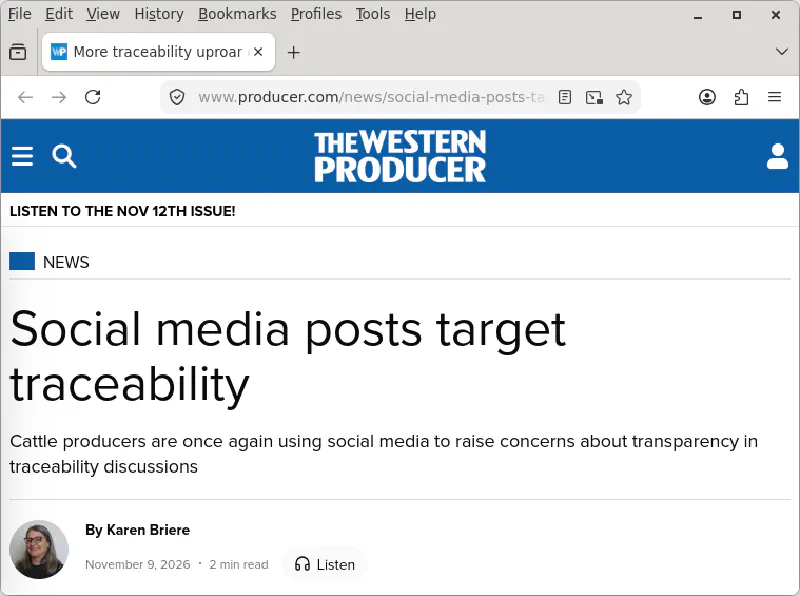
Karen Briere, writing 2026-11-09 in The Western Producer (WP); “Social media posts target traceability”:
The (social media) posts suggest many grassroots producers don’t know the (Canadian Cattle Association) task force exists, who is involved or the direction it is taking.
…
They (producers) want an independent review of potential conflicts of interest, details of producer consultation and the selection of the facilitator on hold until transparency concerns are addressed, among other things.
An online petition has also been initiated.
Exactly where Canada stood 2026-01-09; Cattle producers worry about traceability regulations:
An online petition launched Jan. 8 to stop the changes said they threaten cattle operations.
“I believe that these regulations in the long term will lead to total government control, echoing concerns from the European agricultural sectors,” wrote Julia Fairbrother in launching the petition.
At Agri-Trade Flokk talked to two dozen ranching families about traceability. All of them accepted the necessity for animal movement reporting and every one of them are prepared to participate if provided a solution making movement reporting affordable and not disruptive to ongoing operations.
Producers are not holding up progress on traceability. Resistance from a vocal minority is being exploited as excuse to shun accountability, and pursue study and delay, to avoid assigning a project sponsor, setting a plan, and allocating resources.
This is confirmed by former Agriculture and Agri-Food Canada (AAFC) employee David Cox in his story shared 2026-11-20: “Former civil servant questions traceability delay”:
Cox said he raised concerns for years about how the government was handling traceability. He alleged that money allocated by Agriculture Canada to CFIA for traceability was spent elsewhere and employees assigned to the file were cut.
Canada is failing to engage, protect from harm, and mobilize the producers who would be most impacted by a failure in traceability and who would eagerly adopt a traceability, productivity, and sustainability solution for their herds; Canadian Cattle Young Leaders.
Flokks founder successfully delivered dozens of projects where a project sponsor required change in behaviour not embraced by every customer of the project.
Only one strategy succeeds:
The path of least resistance for the customer must be the path that realizes the outcome required by the project sponsor.
Imposing disruption to a customer achieving an outcome they require (profitably selling calves) will never realize animal movement reporting. Animal movement reporting must be integral with the most profitable path to selling calves.
Reward good behaviour. Do not acknowledge bad behaviour.
Rewarding bad behaviour (making uninformed and unreasonable objections) with a delay in the change in behaviour required of that actor (animal movement reporting) only causes bad behaviour to be repeated.
Punishing bad behaviour just entrenches resistance. Apply resources, and make decisions, only to the service of customers receptive to adopting the change.
This principle does not provide excuse for unresponsiveness to legitimate issues.
Leave peer pressure to resolve those resisting adoption.
If resources, and reward, are allocated to customers prepared to adopt the change then customers who resist adoption will, irresistibly, become the minority and will, irresistibly, succumb to peer pressure. Peer pressure is the only influence universally irresistible that can be invoked without conflict.
Albert (not their real name) is a fourth generation rancher; the calmest, rational, best informed and most successful producer I know. After attending s producer meeting where producers were resisting traceability Albert was outraged at his peers. Given Canada’s experience with BSE Albert believes it irresponsible for the nation, or any Minister, province, organization or producer, to not pursue every opportunity to secure simple and affordable solutions providing any, let alone substantial, mitigation to the $75B in losses which will occur from an unmanageable, and inevitable, outbreak of FMD in Canada.
Albert reflects the majority of Canadian cow/calf producers. Serve Albert, and the remainder irresistibly follow.
The complete social media post referred to in the 2026-11-09 WP article can be found here. In summary, the post identifies:
These issues are legitimate. The CCA Task Force has no legitimacy moving to “Phase 2” when it has failed to even attempt to, let alone actually, secure a mandate.
The Canadian Cattle Association responded to the social media post with “Response to Misinformation about Traceability Task Force Request for Proposals”:
Task Force updates and milestone reports will be shared at key stages of the process, with opportunities for producer engagement. We remain committed to a transparent, credible process that delivers practical recommendations for Canada’s beef industry.
If you missed the task force announcement, please see:
What the CCA neglects to share in the 2026-06-09 announcement of the CCA Task Force or the 2029-11-09 response is:
Producers are correct; Flokk can not see how the Canadian Cattle Association Traceability Task Force can make any useful contribution to realizing Canadian cattle traceability.
Their are four potential origins for an infectious disease outbreak in cattle imposing significant impact, three inevitable:
Bovine tuberculosis:
One example presented by CFIA’s Dr. Heather Brown demonstrated the practical difficulty of reconstructing movements from paper and incomplete records. CFIA attempted to trace nine heifers that had passed through an auction and several subsequent transactions. The exercise required approximately 25 to 30 staff hours, extended over more than 60 calendar days, and located only two animals in a breeding herd and confirmed two others as slaughtered. Five of the nine animals remained untraceable.
Foot and Mouth Disease:
A highly contagious disease such as (FMD) would be more serious than Bovine Spongiform Encephalopathy (BSE) because it could spread rapidly among cattle, hogs, sheep, goats, and other cloven-hoofed animals. Current Canadian industry estimates place the potential economic impact of an FMD outbreak at between 22.6 billion and 75.8 billion, depending on the scale, spread, and duration of the disruption.
…
FMD is coming, just question of when
H5N1 (bird) flu:
Chronic Wasting Disease in Deer:
Mr. Cox’s experience proves the traceability can has been kicked down the road for decades by accountable Canadian leaders in the hope that a catastrophe that traceability would be necessary to mitigate; outbreak of an infectious disease in livestock presenting major impact, would conveniently defer itself to their successors watch.
Unfortunately for Ministers Michels, MacDonald, Paton, Sawyer, Marit, Kostyshyn, Jones, Martel et al., the roulette ball just dropped into a pocket.
David Cox’s experience reflects Flokk’s experience; after two decades of delay Canadian beef livestock traceability remains unrealized not because of producer resistance but because traceability has not been addressed as a project with sponsor, resources, and plan.
Here is that plan, in order of priority and execution:
There are more than 36 entities, many holding authority but taking no accountability, many with accountability but having no authority or resources, and many offering neither, all claiming legitimacy as stakeholder on the Canadian livestock traceability file.
Action item 1 from “Accountability and innovation are required for Canada to secure livestock animal traceability”:
Lock Marjorie Michel, Heath Macdonald, the provincial Ministers of Agriculture, Andrea Brocklebank, Kevin Boon, Brad Dubeau, Christina Patterson - Betker, Carson Callum, Richard Horne and Steve Harrison in a hotel until they identify a single entity accountable for, and holding resources necessary to, comprehensively set, realize and sustain mandatory data reporting requirements for Canadian ranchers.
The actors remain the same (the broader objective we proposed is now likely too ambitious) and the necessary outcome remains; one leader holding accountability and capacity to allocate necessary resources.
This assignment must resolve the disconnect between holder of the traceability file; the CFIA reporting to Minister of Health Marjorie Michel, and accountability for producers impacted by traceability, held by Minister of Agriculture and Agri-Food Heath MacDonald.
Every stakeholder; project sponsor, regulator, responsible administrator, Provincial Ministers of Agriculture, CCA, ABP, SCA, and every provincial producer association must unconditionally commit to implementing the draft regulation published 2023-03-18 in Canada Gazette, Part I, Volume 157, Number 11.
It is negligent to continue to expose the majority of Canadian cow/calf producers (and in particular Canada’s recent entrant cow/calf producers) who are prepared to participate in animal movement reporting to the existential, and inevitable, risk to their families, herds, and ranches from an unmanageable outbreak of FMD.
Repeating from Mr. Cox’s story:
Cox said he raised concerns for years about how the government was handling traceability. He alleged that money allocated by Agriculture Canada to CFIA for traceability was spent elsewhere and employees assigned to the file were cut.
Traceability has not been realized because the meagre funds allocated to it have been wasted on examination and study (e.g. the CCA Task Force) while none (Flokk can confirm this from direct experience) has is available for implementation.
But current strategy of the CFIA, CCIA, and provincial extension departments; apply punitive incentive (financial penalty) to secure traceability compliance, will at best secure a single objective (traceability) while leaving huge opportunity unrealized.
And even this unambitious objective is unlikely to be realized.
Flokk has always understood that traceability alone does not provide sufficient value proposition for a rancher to implement digital agriculture. And no one is motivated to pursue constructive change by threat alone; ranchers even less so that most.
Billions in federal public funds have been allocated for digitization initiatives. These funds can, and must, be mobilized to realize livestock animal traceability.
Provincial Ministers of Agriculture express support for traceability but defer accountability, and resources, for realization to federal actors. Provinces must get on board and mobilize provincial resources in support of a national plan for traceability, or stand aside and let innovators work with federal resources and provincial producer associations to deliver traceability.
One group, five members, speaking authoritatively for the industry. Not 36 (CCA, 10 X 3 industry domains X 10 provinces) uncoordinated investigations and dissonant voices.
ABP established two important principles in their “Report from the ABP Working Group on Traceability”:
These principles must apply to the entire national traceability project.
Accountable does not mean uncoordinated and not resourced; sufficient resources must be provided, and solutions and supporting artifacts developed nationally.
Provincial producer associations must turn to the industry’s youth, for example 4H and Canadian Cattle Young Leaders, for leadership, advocacy, and ambassadorship of their initiatives.
Canada’s traceability platform (Canadian Livestock Tracking System) was obsolete when launched in 2000 and so not unsurprisingly remains obsolete in 2026.
(Full details here under “Necessary outcome 3”)
The “Report from the ABP Working Group on Traceability” recommends:
Priority should go to better use of existing low-frequency RFID tags, readers, mobile/offline tools, automatic uploads, and data integration. Newer technologies may be researched although should not delay achievable improvements
With regret, Flokk concurs with the ABP recommendation. Canada has squandered the opportunity to build and prove a traceability solution with modern architecture.
The option remains, and it is the best option, for a ground up rebuild. But that would require a nine digit figure to fund delivery to the necessary urgency.
From “The compelling opportunity digitizing Canadian cow/calf ranching”:
Two day quadruple play: All four of traceability, sustainability, productivity, and export market readiness delivered to a ranch at little incremental cost, and similar disruption, than that required to deliver any one outcome in isolation
Voluntarily securing participation from producers requires they are offered a compelling value proposition with net positive return. Traceability alone cannot offer this value proposition. Producers must be offered an integrated solution securing opportunities in productivity and sustainability as well as traceability.
A larger topic for resolution another day, Flokk has identified the Canadian agriculture innovation ecosystem incapable of meeting this innovation need.
Even if, as per the ABP recommendation, Canada’s current traceability architecture is retained a significant, and exceptional, innovation program will be required to independently identify, commercialize, validate, and prepare for delivery the necessary integrated offering.
Flokk has assembled a coalition of authoritative Alberta agriculture innovation actors, including a funding agency, that will be rapidly mobilized to delver the necessary innovation support.
A project consisting of:
would have beef traceability delivered by end of 2027, not just studied once again as the CCA proposes.
Come join us!


© 2026 Flokk Systems Inc. All rights reserved.